
World Cup Prediction Markets Explained: How Soccer Trading Works on Novig
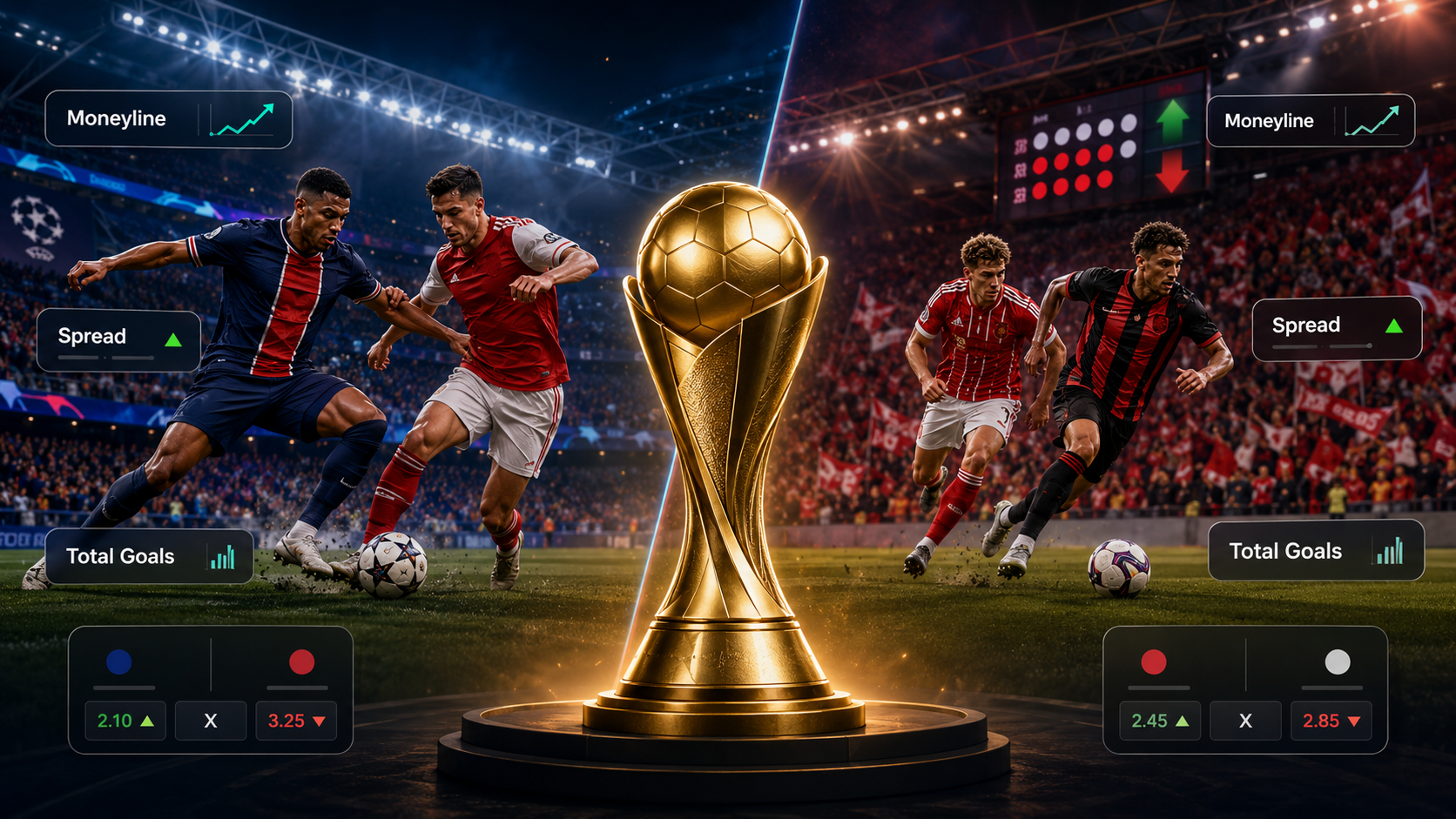
The World Cup is approaching, and with it comes one of the highest volume (and most volatile) markets. Traders will have to think through the shape of each match: is the favorite likely to win outright, or is the underdog dangerous enough to cover a spread? Does the matchup point toward goals, or does the occasion push both teams into a tighter game? Is the price actually worth taking, or is the market charging too much for the obvious side?
Those same questions show up across every major soccer competition. A Champions League final gives traders the closest version of a World Cup knockout match: two elite teams, heavy tactical pressure, and a market that can swing on one lineup decision or one early goal. A Premier League final-day match looks more like a World Cup group-stage spot, where qualification math, scoreboard pressure, and risk tolerance can matter as much as team quality.
PSG vs Arsenal and Nottingham Forest vs Bournemouth give us two useful examples. One is a trophy match between two European heavyweights. The other is a final-day league game with Bournemouth chasing a Champions League spot and Forest trying to spoil the script. Together, they show how spread, total goals, and moneyline markets work in soccer — and how those same markets translate to World Cup trading.
Champions League Final Example: PSG vs Arsenal
PSG and Arsenal meet in the Champions League final at Puskás Aréna in Budapest. The matchup has the feel of a World Cup knockout game: star power, global betting interest, and very little room for tactical mistakes. UEFA lists the final for Saturday, May 30, and the tactical setup is already clear: Luis Enrique has praised Arsenal’s out-of-possession defensive structure, while PSG’s pressing, speed on the wings, and attacking movement give Arsenal a completely different kind of problem than most Premier League opponents.
Spread: trading the result with a cushion
The spread market adds a handicap to the match result. Arsenal +0.5 at -150 gives Arsenal a half-goal cushion, so that position is built around Arsenal avoiding defeat. PSG -0.5 at +116 is the more aggressive side because PSG need to win.
That distinction is central to World Cup trading. In a group-stage match, a favorite may be the better team, but the underdog can still be the sharper spread position if a draw is realistic. In a knockout match, the favorite can control possession without turning that control into a regulation win.
PSG-Arsenal gives traders both sides of that argument. PSG are the favorite on the moneyline, but Arsenal +0.5 is priced as the safer spread position because a draw within 90 minutes is very possible in a final. Arsenal’s unyielding defense and set-piece threat make them difficult to separate from, while PSG’s pace and attacking depth create the kind of one-moment danger that can justify laying the half-goal at plus money.
Total goals: trading the match script
The total goals market removes the winner from the equation. Over 2.5 at -103 needs three or more goals, while under 2.5 at -127 needs two or fewer.
For World Cup betting, totals often come down to whether the match is more likely to open up or stay tense. Finals and knockout games can start carefully because neither team wants to chase from behind. At the same time, one early goal can flip the entire tempo, especially when both teams have enough attacking talent to punish space.
That tension is visible in PSG-Arsenal. The Under is the more expensive side, which suggests the market respects the final-stage pressure and Arsenal’s defensive quality. The Over is close to even money, though, and PSG’s attacking profile keeps it from feeling like a pure cage match. Traders do not need to pick the winner here; they only need to decide which version of the match is more likely.
Moneyline: trading the winner
The moneyline is the simplest market on the board: pick the team that wins. PSG are -152, while Arsenal are +122.
That price makes PSG the favorite, but not an overwhelming one. Arsenal are still close enough to be treated as a true finalist, not a longshot. In World Cup knockout trading, this is often the first number people check because it answers the obvious question: who wins?
The catch is settlement. Soccer winner markets can vary by platform. Some settle after regulation, while others may be tied to advancement, extra time, or penalties. World Cup markets will have the same issue, so traders should always check whether they are trading a 90-minute result, a team to advance, or a tournament-style winner market.
Premier League Final-Day Example: Nottingham Forest vs Bournemouth
Nottingham Forest vs Bournemouth plays differently from a final, which is why it is a useful second example.
Bournemouth enter the final day chasing a Champions League path, while Forest have the chance to disrupt that push at home. Bournemouth already beat Forest 2-0 earlier this season, and their attack has leaned heavily on Junior Kroupi, who has 13 league goals. Forest’s midfield has a different kind of influence through Elliot Anderson, who has contributed four goals and two assists.
That kind of setup is common in World Cup group play. One team may need a win to advance. The other may only need to manage the match, protect goal difference, or play spoiler. The market is not only pricing team strength; it is pricing urgency, scoreboard pressure, and how aggressive each side is likely to be once the match state changes.
Spread: trading pressure, not just talent
Bournemouth -0.5 at +105 means Bournemouth need to win. Forest +0.5 at -139 means Forest are positioned around avoiding defeat.
That is exactly the kind of decision World Cup group traders face. A team chasing qualification may have the stronger squad and the greater need, but need can cut both ways. It can sharpen a favorite’s focus, or it can make that favorite impatient if the match stays level past halftime.
Bournemouth -0.5 is the direct belief in the chase: the better table position, the prior 2-0 win over Forest, and enough attacking quality to finish the job. Forest +0.5 is the pressure fade: home underdog, draw protection, and the chance that Bournemouth’s Champions League math gets heavier the longer the match stays tight.
Total goals: trading urgency
Bournemouth-Forest has Over 2.5 at -162 and Under 2.5 at +144.
The Over is priced as the more likely side because the match has a natural path to chaos. Bournemouth may need goals depending on other results, and Forest can benefit from the space that opens if the visitors start forcing the game. This is how many World Cup group finales behave: one goal changes not only the match, but the live incentives for both teams.
The Under is the bigger payout because it needs the more restrained version of the game. That can still happen. If Forest sit deeper, Bournemouth miss early chances, or other results make control more valuable than risk, the match can settle into a lower-event rhythm. The key is that the total is not only about attacking quality; it is about how the standings affect risk.
Moneyline: trading the must-win side
Bournemouth are -167 on the moneyline, while Forest are +148.
That price tells a straightforward story: Bournemouth are favored because they have more to play for and the stronger season profile. But moneylines demand the full result. A dominant 1-1 draw does nothing for Bournemouth moneyline traders, even if Bournemouth win the shot count, possession battle, and territory.
World Cup moneylines work the same way. The favorite may be the better team, but the market only cares about the result defined in the rules. In group play, where a draw can be enough for one side and a disaster for the other, traders should be careful about treating motivation as automatic conversion.
How This Translates to World Cup Markets
World Cup trading starts with the same three questions these examples raise.
The first is result risk. If a favorite simply needs to win, the moneyline is the most direct position. If the underdog can make a draw valuable, the spread may offer a better way to trade the match without calling the outright upset.
The second is game state. Totals can move fast in soccer because one goal changes incentives. A 0-0 match between two teams that both need a point is completely different from a 1-0 match where one side suddenly needs two goals to survive.
The third is settlement. World Cup markets can separate 90-minute results, extra time, penalties, qualification, and tournament advancement. A team can draw the match and still advance. A team can win after penalties but fail to cash a 90-minute moneyline. The price only makes sense once the market rules are clear.
That is why soccer trading rewards more than team knowledge. The best positions usually come from matching the price to the game script: favorite pressure, underdog draw equity, goal environment, and tournament incentives.
Trade Soccer Markets on Novig
PSG-Arsenal shows how a major final can be traded through spread, total, and moneyline. Nottingham Forest-Bournemouth shows how final-day pressure can reshape those same markets when one team is chasing a bigger outcome.
World Cup trading follows the same logic. Group-stage matches often hinge on who needs the result and how much risk they are willing to take. Knockout matches bring tighter margins, sharper tactical decisions, and extra settlement rules around advancement. On Novig, those markets give traders multiple ways to express the same read instead of forcing every opinion into a single winner pick.
Get your soccer positions on Novig and follow the market as World Cup trading takes shape.
Disclaimer: Odds are accurate as of May 21 at 3:30 p.m. ET and may move before kickoff. Always check current prices, market labels, and house rules before placing any bet or trade. Soccer markets can settle differently by platform, especially for knockout matches, extra time, penalties, spread markets, and draw-related outcomes.


