Last updated: October 10, 2026
Key Takeaways
- Arbitrage betting is generally legal in the U.S. when every wager in it is placed legally where you are.
- Legal does not mean welcome. Sportsbooks can and do limit, restrict or close accounts they suspect of arbing.
- What gets bettors in trouble is the leg, not the arb: a restricted location, a VPN, someone else's account, an eligibility rule.
- Prediction-market arbs sit in an unsettled federal-versus-state question. The Third Circuit sided with Kalshi in April, while the Ninth Circuit ruled against it in August and the Sixth Circuit sided with Ohio and Tennessee on September 25.
- From 2026, federal law caps the wagering-loss deduction at 90% of losses, so arbers can owe tax on more than their net profit.
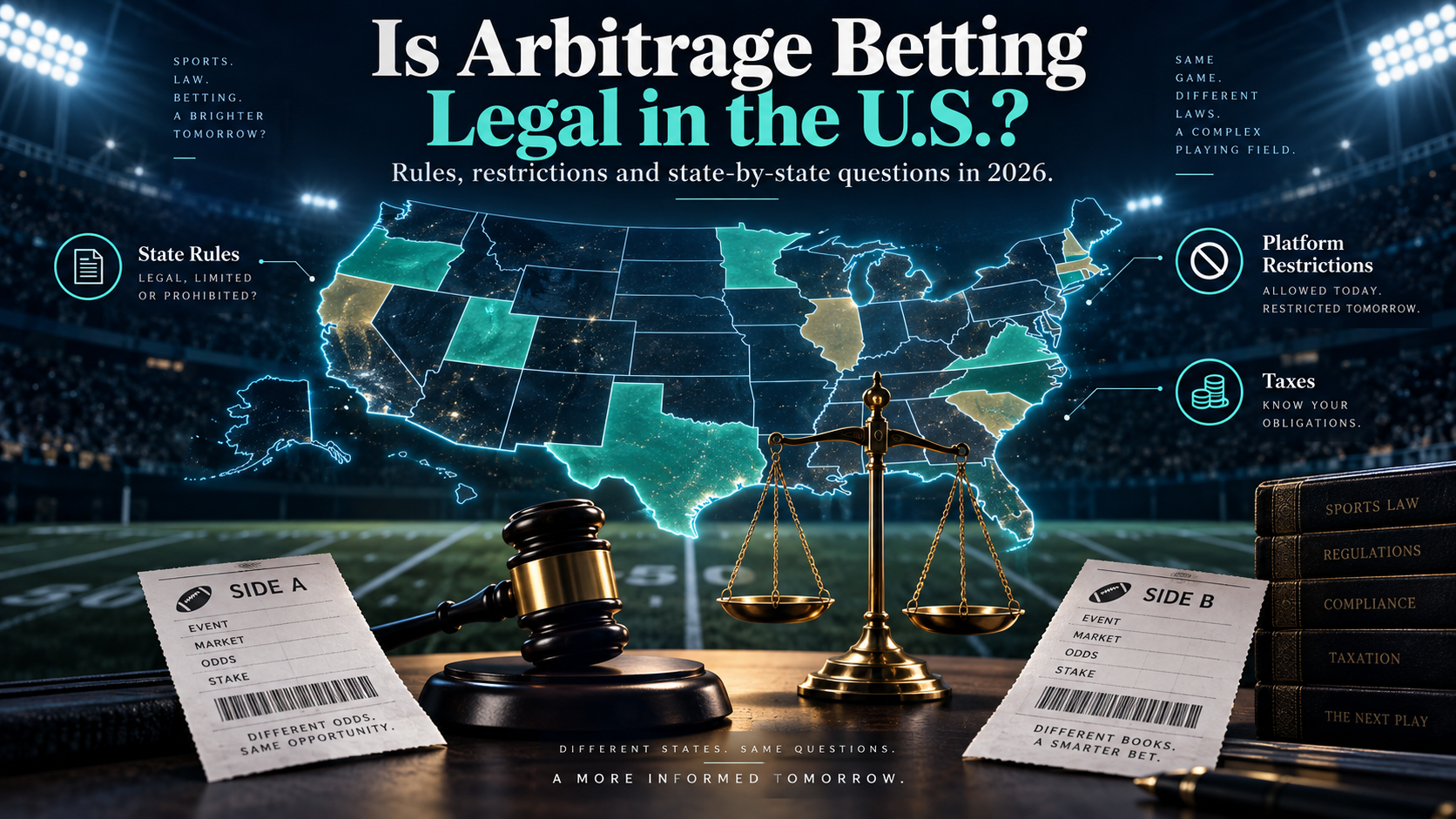
Yes. Arbitrage betting is generally legal in the U.S. when every wager involved is placed legally. Comparing prices and taking opposite sides of an event isn't itself a prohibited betting strategy. The complications come from the wagers underneath the arb and how sportsbooks themselves regulate arb betting.
Why Arbitrage Betting Is Generally Legal
Arbing is a betting technique, not a separate type of illegal wager. You're taking ordinary prices offered by sportsbooks and combining opposing bets so the payouts cover every outcome.
The legal question is really where and how each leg is placed. If two licensed sportsbooks legally accept your wagers where you're physically located, there's no issue. If one sportsbook isn't legal or available where you are, the fact that its price completes an arb doesn't make that wager legal.
Can Sportsbooks Limit Arbitrage Bettors?
Yes. A legal strategy doesn't require a sportsbook to keep offering you the same limits. Sportsbooks generally reserve broad discretion over the wagers they accept. DraftKings, for example, states that it may refuse any wager or part of a wager and can suspend or terminate accounts under circumstances described in its terms. Many operators reserve the right to refuse wagers or restrict accounts for arbitrage, and some name it explicitly in their house rules, though the biggest books rely on broad discretionary clauses instead. Massachusetts now requires an operator to give a written reason each time it limits a patron.
All this means arbitrage can be legal while still being something a sportsbook doesn't want from a particular customer. Limits, rejected bets or account restrictions are platform-policy issues rather than proof that the strategy itself is illegal. They also create practical risk: if one sportsbook accepts the first half of an arb and another lowers your limit or moves its price before you place the second, the supposedly guaranteed trade can turn into an exposed position.
What Can Get an Arb Bettor Into Trouble?
The arb itself usually isn't the problem. Breaking the rules attached to one of its legs can be.
- Betting from a restricted location: sportsbook legality and availability depend on where you're physically located when the wager is placed. In Florida, for example, the only legal sportsbook is Hard Rock Bet, so using another book to complete the arb would be illegal.
- Using a VPN or spoofing location: major operators prohibit technology intended to disguise where you are. DraftKings bars disguising your physical location and bars VPN use outright.
- Using someone else's account: account sharing, proxy betting and duplicate accounts can violate operator terms.
- Ignoring eligibility restrictions: age requirements and rules for athletes, coaches, officials and other prohibited participants still apply.
Are Prediction-Market Arbs Legal?
This is where the answer becomes less straightforward. Traditional sportsbooks operate through state gambling licenses, but federally regulated prediction markets instead list event contracts through exchanges overseen by the Commodity Futures Trading Commission (CFTC). The CFTC continues to regulate event-contract markets and in June 2026 proposed a framework for reviewing contracts tied to gaming and other activities specifically named in the Commodity Exchange Act.
The unsettled question is how that federal system interacts with state gambling laws when the contract is based on a sporting event.
On August 28, 2026, the Ninth Circuit held that Kalshi was unlikely to succeed in showing its sports event contracts are "swaps" under the Commodity Exchange Act, and that Kalshi had not shown federal law likely preempts Nevada's gaming regulations. The panel affirmed dissolution of the injunction as to sports contracts, so Nevada may enforce its gaming laws against them, and remanded the election-contract question to the district court. On September 25, the Sixth Circuit also ruled for Ohio and Tennessee, holding that federal law does not preempt their gambling laws as applied to Kalshi’s sports event contracts. Kalshi petitioned the Ninth Circuit for rehearing en banc on September 9, so that decision is not final. The Third Circuit, hearing the New Jersey case, reached the opposite conclusion in April 2026, leaving the federal appeals courts divided. New Jersey petitioned the Supreme Court on September 2, 2026; Kalshi’s response is due November 9, and the Court has not granted review.
So for now, the answer remains murky. Platform availability can differ by state, and the federal-versus-state boundary for sports contracts remains unsettled. For an arbitrage trader, that means a sports contract should be treated like any other potential leg: first, confirm that the platform currently allows you to trade from your location.
Where Arbitrage Bettors Can Legally Place Both Legs
Legality is decided per leg, so the practical question is which venues will take your bet and keep taking it. These are the five most commonly used by U.S. arbers.
| Venue | Type | Arbitrage Stance | Practical Limit |
|---|
Novig | CFTC-regulated prediction market | No anti-arbitrage clause in its rulebook | Not available in Arizona, Nevada or Michigan |
Kalshi | CFTC-regulated event-contract exchange | Silent in its rulebook | Blocked in Nevada; Ninth Circuit ruling under en banc petition |
Polymarket | CFTC-regulated prediction market | Silent in its rulebook | Enjoined in Nevada; availability contested elsewhere |
DraftKings | State-licensed sportsbook | Reserves the right to refuse wagers and restrict accounts | Legal only in states where it holds a license |
FanDuel | State-licensed sportsbook | Reserves the right to refuse wagers and restrict accounts | Legal only in states where it holds a license |
The pattern is consistent. State-licensed sportsbooks accept arbitrage as legal and still reserve the right to stop serving you. Federally regulated prediction markets do not have the same incentive, because they match you against another trader rather than taking the other side themselves.
What Does This Mean for Novig?
Novig is a CFTC-regulated designated contract market, not a state-licensed sportsbook. The exchange entity is Ludlow Exchange, LLC, doing business as Novig, designated in June 2026 and clearing through Bitnomial. Its current eligibility rules require users to be at least 21 and physically located in an eligible U.S. jurisdiction when they trade. As of September 2026, Novig is available nationwide except for Arizona, Nevada and Michigan.
For arbers, Novig also behaves differently from a conventional sportsbook. Traders buy and sell against other market participants, and users can post their own prices rather than only accepting a bookmaker's line. As a bonus, unlike traditional sportsbooks, Novig allows arbitrage trading and doesn't treat it as malicious or manipulative activity.
That gives you another independently priced sports market to compare when looking for discrepancies. It doesn't override location rules or guarantee that every two-sided opportunity will fill, but it expands the pool of prices available to eligible traders.
Do You Pay Taxes on Arbitrage Betting?
Yes. Using opposing wagers to lock in a profit doesn't make sportsbook winnings tax-free, and a 2026 tax change makes recordkeeping especially important for arbers. Beginning in 2026, federal law limits the deduction for wagering losses to 90% of those losses, up to the amount of wagering gains. That means a bettor who wins $50,000 and loses $50,000 in a year deducts $45,000 and reports $5,000 of income on a break-even result. It has nothing to do with using several sportsbooks. Two conditions matter: the loss deduction is itemized, so anyone taking the standard deduction gets none of it, and for professional gamblers business expenses count inside the capped amount.
Tax treatment depends on individual circumstances, so high-volume arbers should keep complete records of every wager rather than tracking only the final profit shown by an arb calculator.
Bottom Line: Is Arbitrage Betting Legal?
Arbitrage betting itself is generally legal in the U.S. The important question is whether each individual wager is legal and permitted where you place it.
For traditional sportsbooks, that means following state availability, geolocation and account rules. Prediction-market arbs add another layer because federal exchanges and state gaming regulators are still contesting where authority over sports contracts begins and ends, so for now the simplest solution is to treat them like traditional books and check legality in your state before placing a bet.
Novig gives eligible traders another peer-to-peer sports market to compare when searching for price differences. Check current prices on Novig alongside the legal sportsbooks and markets available where you trade.