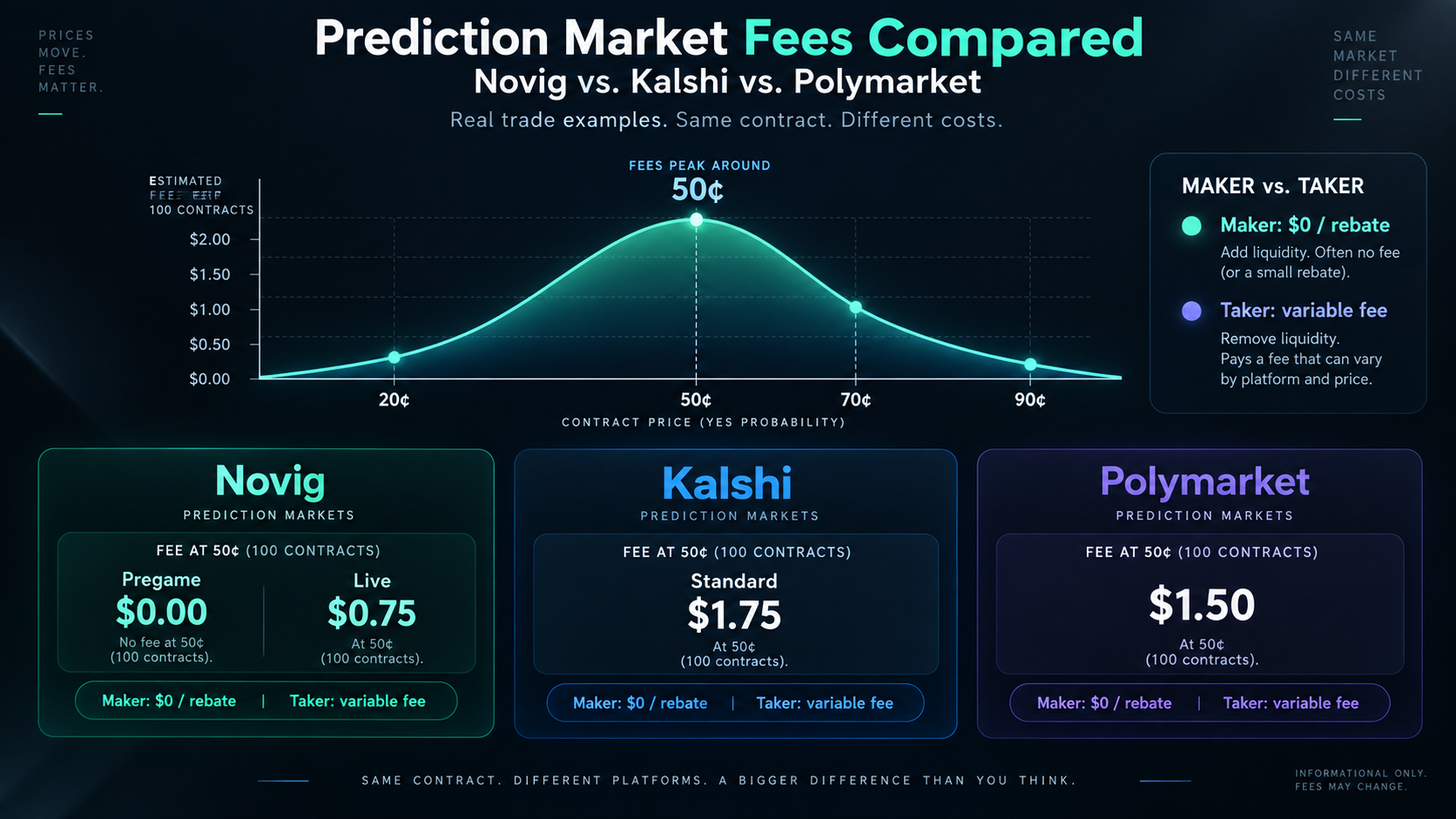
Prediction Market Fees Compared: Novig vs. Kalshi vs. Polymarket
Prediction-market fees add up quickly for active traders. Compare Novig, Kalshi and Polymarket with real examples showing what the same trades cost on each platform.
READ FULL ARTICLE
0
1
2
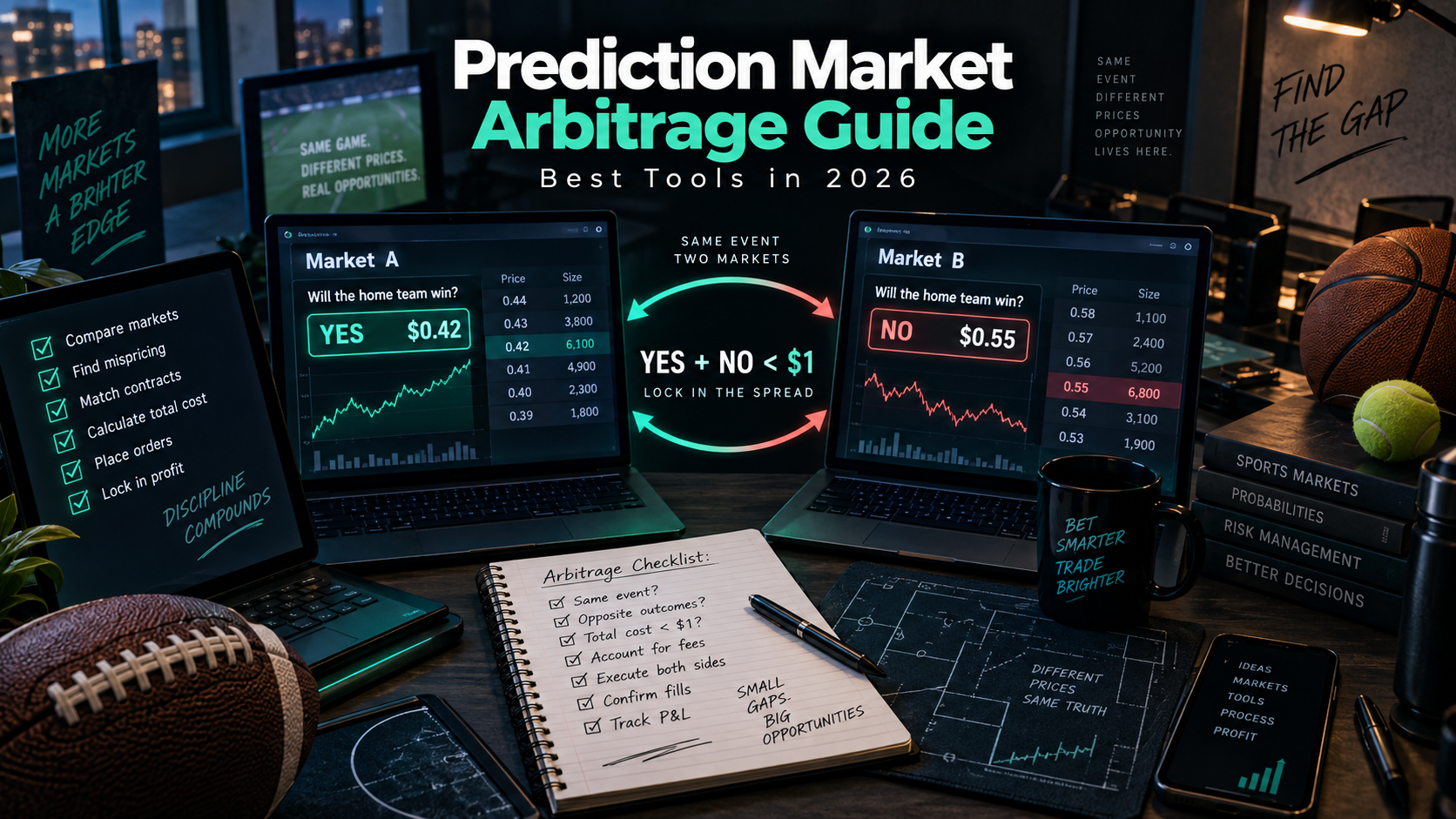
Prediction market arbitrage takes advantage of two venues pricing the same outcome differently. Say YES costs 54¢ on one exchange and the matching NO costs 42¢ on another, and both pay $1. The combined 96¢ leaves 4¢ before fees. That is the whole idea: play both sides and lock the difference.
Finding the gap is the easy half. The contracts have to settle on the same outcome, both prices need usable size behind them, and both orders have to fill before either market moves. The gaps show up between prediction markets such as Novig, Kalshi and Polymarket, or between a prediction market and a sportsbook.
The basic test is simple:
YES price + NO price < either side's payout
If your total costs are less than the lowest payout, whichever side wins the bet will still give you more money than you put in. But before treating that number as profit, check four things.
1. Make sure the contracts actually match. "Boston to win" and "Boston to win in regulation" don't cover the same outcome if overtime is possible. For example, futures can differ on deadlines, cancellation rules or what qualifies as a winning result. Prediction-market contracts are settled according to their individual rules, so similar titles aren't enough.
2. Use prices you can trade. A market might display 42¢ while only a handful of contracts are available there. If the rest of your order fills at 44¢ or 45¢, the return shrinks or disappears. Check the actual bid or ask and the depth behind it.
3. Include fees before sizing the trade. A two-cent pricing gap isn't useful if transaction costs eat three cents. Fees vary by venue and order type, so always check the pricing behind the platforms and specific lines before assuming you've found a real arb gap. Novig currently charges no trading fee on pregame straight trades, while live takers pay a price-based fee.
4. Assume either leg can move. If your first order fills and the hedge disappears, you're left exposed to the result. Live sports are especially unforgiving because the underlying probabilities can change in seconds, which makes speed (and often software) essential for getting the arb down as close to the calculated profit as possible.
Those four checks explain why prediction-market arbitrage tools do more than compare two percentages. The useful ones match contracts, read executable prices, account for costs and help shorten the gap between the first fill and the second.
There are three common setups.
The Same Outcome on Two Prediction Markets
Kalshi, Polymarket and Novig can all price the same event differently, because each one has its own traders, liquidity and order flow. Novig's book is sports-only, so the pool of participants setting its prices is not the pool setting prices on a general-purpose exchange. If the cheaper opposing contracts cost less than $1 combined after fees, the difference can be arbitraged.
Contract matching is the hard part. One venue uses a ticker, another a natural-language question, and both resolve to the same event. Arbitrage Agent uses semantic matching for exactly this. Large active markets correct obvious gaps fast; thinner or longer-dated contracts stay apart longer but offer less size.
A Prediction Market Against a Sportsbook
Sports traders have another option: use a sportsbook for one side and a prediction market for the other. Prediction markets, especially with their user-driven prices, can offer more competitive or unusual lines than a carefully calculated traditional sportsbook, which gives them a unique advantage for arbers seeking gaps in the market.
OddsJam advertises more than 150 sportsbooks and shows combinations involving Kalshi, Polymarket, Novig and ProphetX, and says its users put $52M through those four venues last year. A hedge doesn't care whether both legs came from prediction markets. It needs compatible outcomes and a combined cost below the payout.
Related Contracts on One Exchange
Some arbs come from inconsistencies among several contracts on the same platform. Imagine a market with mutually exclusive outcomes where exactly one must win. If buying enough contracts to cover every possible result costs less than the guaranteed payout, the set is mispriced.
These trades are usually called combinatorial or same-market arbitrage; they can involve several legs and more complicated sizing, so they're less practical for someone learning with standard sports markets. Cross-platform price differences are easier to identify and verify.
Different tools solve different parts of the workflow. A sports trader comparing Novig against sportsbooks needs something different from a developer trying to automate Kalshi-versus-Polymarket execution.
| Tool | Best For | Coverage | Main Differentiator | Execution |
|---|---|---|---|---|
ArbBets | Dedicated prediction-market scanning | Multiple prediction markets | Contract matching, fee-adjusted opportunities, API access | Manual / API |
OddsJam | Sports cross-market arbitrage | 150+ sportsbooks advertised, including Novig, Kalshi, Polymarket and ProphetX | Combines sportsbooks with prediction-market prices | Manual |
Arbitrage Agent | Kalshi vs. Polymarket | Kalshi and Polymarket | Semantic contract matching | Automated parallel execution |
Claw Arbs | Automated arbitrage | Multiple prediction markets and betting venues | Detection and two-leg automation | Automated |
Kairos | Cross-exchange trading | Kalshi, Polymarket and Predict.fun | Aggregated order book and routed trading | Manual / advanced orders |
ArbBets: Best Dedicated Prediction-Market Scanner
ArbBets is narrowly focused on finding cross-platform prediction-market discrepancies. It scans multiple exchanges, matches equivalent events and calculates opportunities after fees rather than comparing headline probabilities alone. The platform also offers API access for traders who want the data inside their own system.
For someone whose trading already happens across prediction markets, this is an excellent arb option. However, sports bettors regularly using DraftKings, FanDuel or other sportsbooks will get less value from its narrower venue mix.
OddsJam: Best for Sportsbook-to-Prediction-Market Arbs
OddsJam casts the widest net. Its arbitrage page advertises more than 150 sportsbooks while the Platinum card says 104+, but either way it pairs prediction markets against sportsbooks. That is the advantage: if Novig has the best Over and a sportsbook the best Under, OddsJam surfaces the pair instead of waiting for another exchange to provide the hedge.
Arbitrage Agent: Best for Kalshi and Polymarket Matching
Arbitrage Agent matches equivalent Kalshi and Polymarket contracts, using semantic matching to connect differently worded events. Its engine sends both orders in parallel with a circuit breaker that unwinds if one side fails. That specialization limits it outside those two exchanges, but it attacks the two real problems: contract matching and leg risk.
Claw Arbs: Best for Automated Multi-Venue Execution
Claw Arbs automates more of the process, connecting to feeds, finding cross-venue discrepancies and executing both sides. That is valuable in a fast market, but it front-loads the work: position sizing, API permissions, partial fills and failure handling all have to be configured before you trust it with money.
Claw publishes aggressive latency claims for its own system, but those figures haven't been independently benchmarked against the other tools here. Its most meaningful value is automated two-leg execution, not a self-reported millisecond number.
Kairos: Best for Traders Who Want One Order Book
Kairos is a terminal, not an alert service. It merges Kalshi, Polymarket and Predict.fun into one view, shows best bids and asks, and routes trades to the underlying exchange. It suits active traders who know their markets and want executable prices without keeping several platforms open.
Kairos currently doesn't support Novig, so sports traders building around Novig and traditional sportsbooks will find OddsJam more relevant.
Start with the venues you actually trade, then consider the features that will actually affect your particular setup. Do you care about volume? Level of automation? How about ability to customize alerts and manually oversee the process?
Novig adds another independently priced sports market to compare against sportsbooks and prediction exchanges.
Pregame straight trades currently carry no trading fee for either makers or takers, which keeps the arithmetic simple when Novig forms one side of a hedge. Live takers pay a fee of 0.03 × price × (1 − price) per contract, so live opportunities need that cost included before sizing the positions. Makers remain fee-free.
Traders can also post their own price rather than taking what's there. If another venue gives you one side, place a resting Novig order at the price that completes the hedge. It only becomes an arb if that order fills, but you stop waiting for the number to appear on its own. That works best in slower pregame markets.
What is prediction market arbitrage?
Buying both sides of the same outcome on different venues for a combined cost below the payout. If YES costs 54¢ on one exchange and the matching NO costs 42¢ on another, and both pay $1, the 96¢ total leaves 4¢ before fees.
What is the best prediction market arbitrage tool?
It depends which venues you trade. ArbBets is the dedicated prediction-market scanner, Arbitrage Agent is built for Kalshi against Polymarket, Claw Arbs automates two-leg execution, Kairos merges order books into one terminal, and OddsJam is the one that spans sportsbooks and prediction markets together.
Is prediction market arbitrage risk-free?
No. Contracts can settle on different rules, displayed prices can have almost no size behind them, fees can be wider than the gap, and one leg can fill while the other moves. Each of those turns a locked return into an open position.
Does Novig charge fees on arbitrage trades?
Not on pregame straight trades, for makers or takers. Live takers pay 0.03 × price × (1 − price) per contract, and live makers remain fee-free.
A genuine prediction-market arb has to survive more than the initial price comparison. The contracts need compatible settlement rules, the displayed prices need enough liquidity behind them, fees have to fit inside the spread and both sides need to fill. Software can handle much of that work, but the right product depends on where you trade.
For sports traders, Novig adds another peer-to-peer price to that comparison, with no trading fee on pregame straight trades. Compare current sports markets on Novig when you're looking for cross-market pricing gaps.
1
2
2
Prediction-market fees add up quickly for active traders. Compare Novig, Kalshi and Polymarket with real examples showing what the same trades cost on each platform.
Compare five leading sports prediction markets by sports depth, fees, scale and overall fit. See which platform makes the most sense for how you trade.
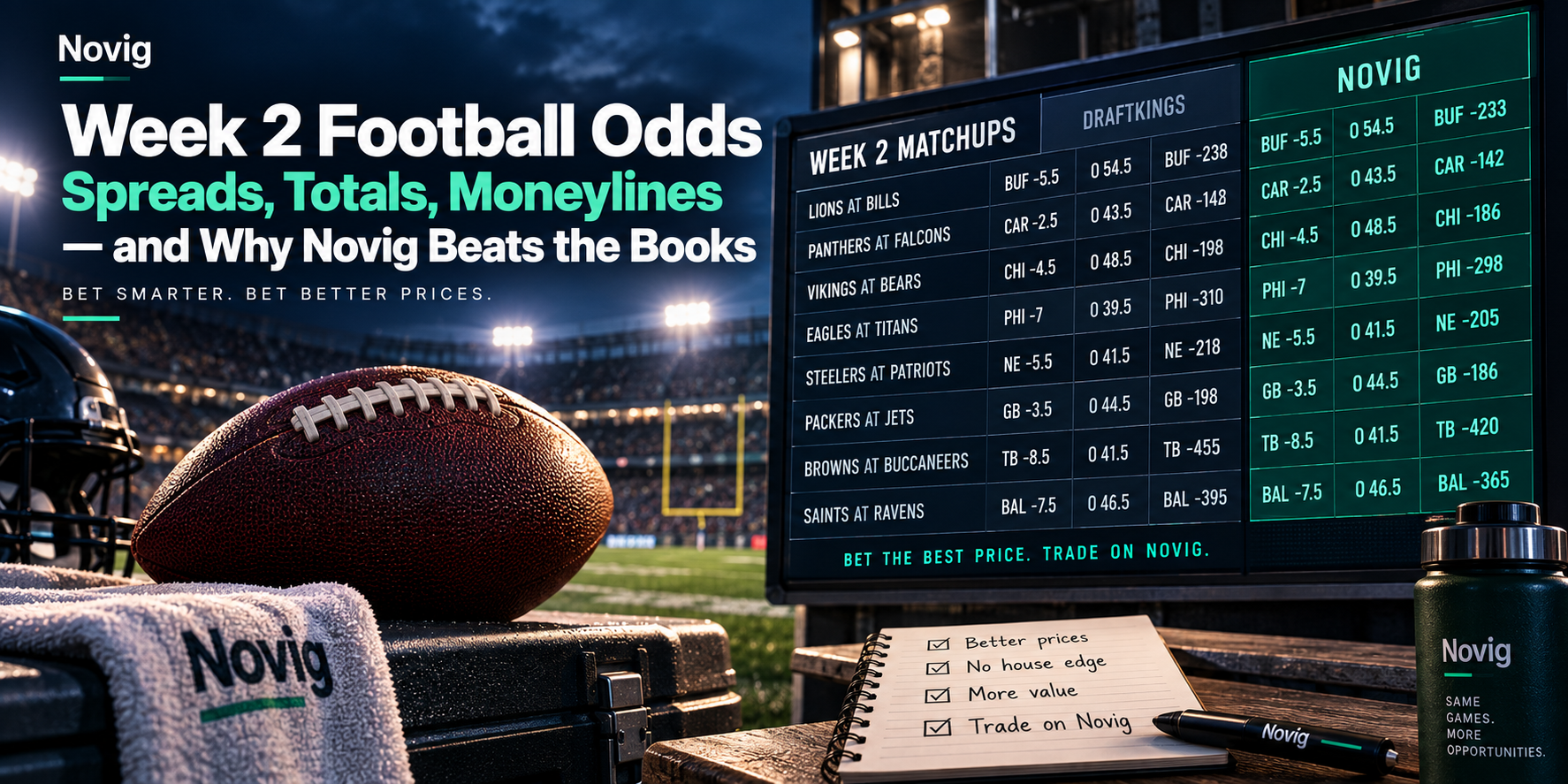
Compare every Week 2 NFL matchup for 2026, including spreads, totals, moneylines, home win probabilities, and DraftKings vs. Novig pricing.