
How the 5 Best Prediction Markets for Sports in 2026 Stack Up
Compare five leading sports prediction markets by sports depth, fees, scale and overall fit. See which platform makes the most sense for how you trade.
READ FULL ARTICLE
0
1
2
The more you trade, the more fees or commissions eat into your winnings, so what a platform charges changes what you take home.
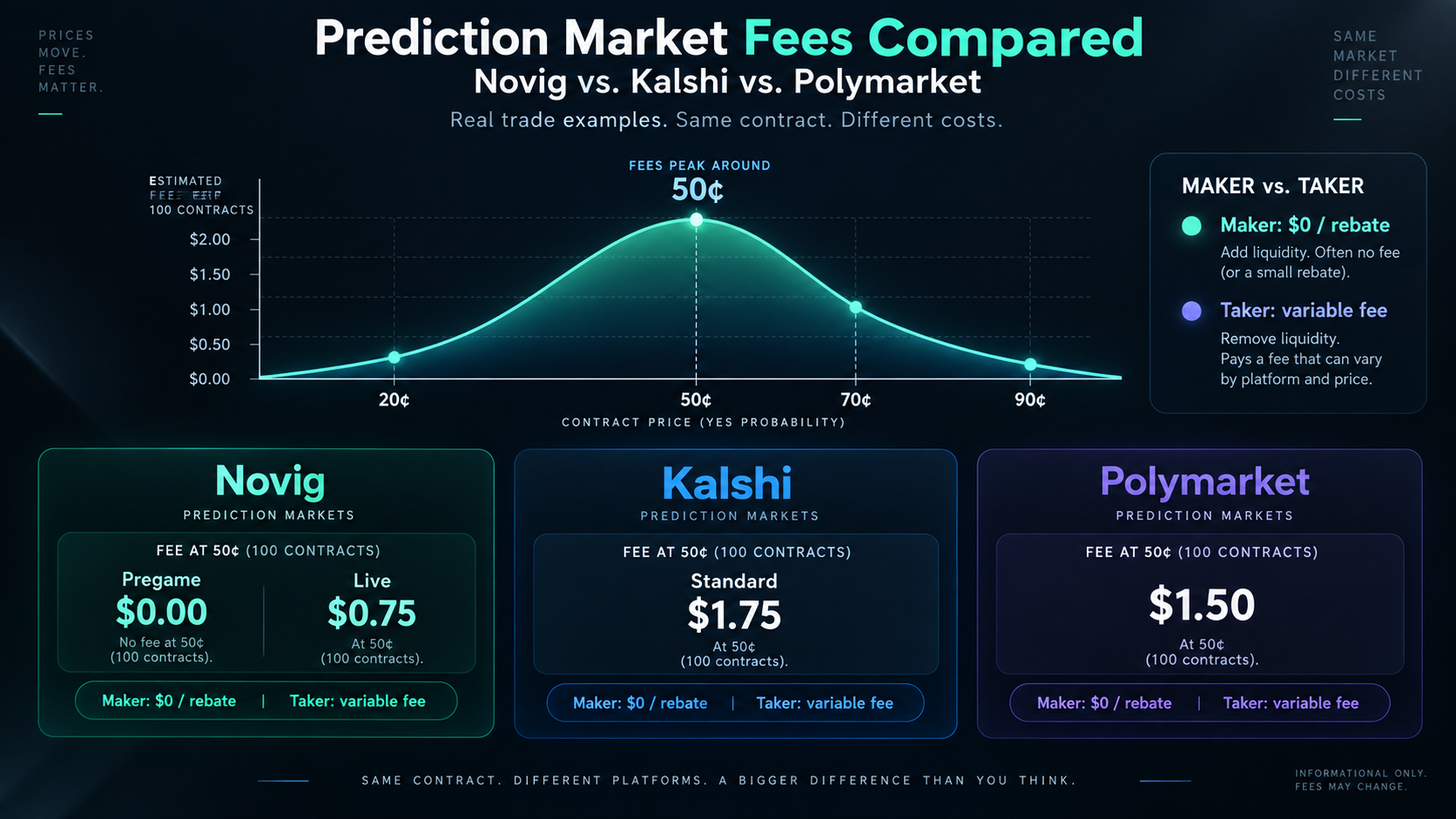
At 100 contracts priced at 50¢, a pregame straight trade costs $0 in trading fees on Novig, $1.50 as a Polymarket taker and $1.75 under Kalshi's standard taker schedule. Move the Novig trade in-game and its fee rises to 75¢.
Novig is the simplest option for pregame sports trades. Polymarket rewards traders who make markets instead of taking available prices, and Kalshi's costs depend more heavily on the individual market and whether your order rests on the book.
| Fee Type | Novig | Kalshi | Polymarket |
|---|---|---|---|
Pregame straight taker | $0 | $1.75 | $1.50 |
Live straight taker | $0.75 | $1.75 | $1.50 |
Maker | $0 + 50% live credit | Some maker fees | Maker rebate |
Dollar examples use 100 contracts priced at 50¢. Kalshi figures use its standard taker schedule; individual markets can use different fee multipliers or maker fees. Novig's 50% live maker credit is based on the taker fee collected from the other side of an eligible trade.
Novig's live straight trades, Kalshi's standard taker trades and Polymarket taker trades all use the same basic fee shape:
Fee = coefficient × number of contracts × price × (1 − price)
The coefficient changes by platform:
Because the calculation includes price × (1 − price), the fee peaks around 50¢ and falls as a contract moves toward either 1¢ or 99¢. A coin-flip market therefore costs more per contract to take than a heavy favorite or longshot.
Here's how that changes the cost of 100 contracts:
| Contract Price | Position Cost | Novig Pregame | Novig Live | Kalshi Standard | Polymarket |
|---|---|---|---|---|---|
20¢ | $20 | $0.00 | $0.48 | $1.12 | $0.96 |
50¢ | $50 | $0.00 | $0.75 | $1.75 | $1.50 |
70¢ | $70 | $0.00 | $0.63 | $1.47 | $1.26 |
90¢ | $90 | $0.00 | $0.27 | $0.63 | $0.54 |
The dollar fee gets smaller near the extremes, but don't confuse that with the fee becoming irrelevant. A winning 90¢ contract earns only 10¢ before fees. Across 100 contracts, Kalshi's 63¢ standard fee takes 6.3% of that $10 potential profit, Polymarket's 54¢ takes 5.4%, and Novig's 27¢ live fee takes 2.7%.
Novig charges no maker or taker trading fee on pregame straight trades on single-game markets: moneylines, spreads, totals, partial-game lines, team totals and player props. Futures are priced separately, with takers paying 0.06 × price × (1 − price) per contract, double the live rate; golf and tennis futures are the exceptions. Live takers pay the variable fee shown above, and makers remain fee-free across every trade type.
Live makers can actually earn money from the fee on the other side. Novig's current Maker Credit Program pays eligible makers a cash credit equal to 50% of the live taker fee collected from their counterparty, and 70% of the taker fee on eligible futures markets. If a taker pays 75¢ on 100 contracts at 50¢, the qualifying maker earns 37.5¢, paid as cash within seven days and only if the fee is actually collected.
Parlays use a separate, higher fee schedule, with the charge already included in the quoted price. We're keeping them outside the straight-trade comparison because there isn't a clean apples-to-apples equivalent across all three platforms.
Kalshi has the highest standard taker rate of the three, but that schedule isn't universal. Kalshi applies a multiplier to individual contract series, currently 156 of them, and rounds the fee up to a centicent. Its July 2026 schedule lists many sports markets with the standard multiplier, while other products have their own treatment.
Resting orders are often cheaper. Kalshi generally doesn't charge its normal taker fee when an order sits on the book before another trader fills it, although 156 series carry maker fees. Those run at 25% of the taker rate for most series, and 50% on Combos.
These line-specific nuances make checking the individual market worthwhile. Two Kalshi trades at the same price can have different fee treatment depending on the series and how the order executes.
Polymarket sits between Novig and Kalshi on standard taker fees, topping out at $1.50 per 100 contracts around 50¢. Makers get the opposite treatment: Polymarket pays them a rebate when their resting orders fill. At 50¢, 100 contracts currently earn the maker about 31¢ instead of charging a transaction fee.
Very active takers can qualify for rebates too. Prior-month taker volume of $250,000 earns a 10% fee rebate, $1 million qualifies for 25%, and $10 million or more reaches 50%. Those tiers won't affect most casual traders, but they can change the comparison for high-volume accounts.
For ordinary retail takers below those thresholds, the standard $1.50 maximum per 100 contracts is the most useful benchmark.
If you usually accept the price already on screen, you're trading as a taker. If you post an order and wait for someone else to fill it, you're making liquidity.
Novig has the strongest maker treatment of the three for sports trades: maker fills carry no trading fee, and eligible live fills can earn a cash credit from the taker fee.
Polymarket also rewards makers, paying a rebate based on price and trade size rather than simply waiving the fee.
Kalshi is more market-dependent. Resting orders can avoid the normal taker charge, but selected series carry maker fees of their own.
For someone placing a few trades a week, that difference may amount to pocket change. At hundreds or thousands of contracts, it becomes part of the price you should compare before choosing a venue.
For pregame straight sports trades, Novig is the clear winner under the current schedules. Makers and takers both pay $0.
For live straight takers, Novig also charges less on equivalent trades. At 50¢ and 100 contracts, the fee is 75¢ versus $1.50 on Polymarket and $1.75 under Kalshi's standard schedule.
For makers, Novig charges nothing and can pay live maker credits, while Polymarket pays direct rebates. Kalshi may also be fee-free for a resting order, but that depends on the market.
Fees still don't tell the whole story; paying 75¢ less in transaction costs doesn't help if another exchange gives you a substantially better contract price. But if the underlying prices are close, repeated fees can turn into a meaningful difference in profit.
Which prediction market has the lowest fees for sports?
Novig, on pregame straight trades, where makers and takers currently pay nothing. On 100 contracts at 50¢, the same trade costs $1.50 as a Polymarket taker and $1.75 under Kalshi's standard taker schedule.
Why does the fee change with the contract price?
Because all three schedules multiply by price × (1 − price). That term is largest at 50¢ and falls toward either end, so a coin-flip market costs the most per contract and a heavy favorite costs the least.
Do makers pay fees on prediction markets?
Not on Novig, where maker fills carry no trading fee and eligible live makers earn 50% of the taker fee paid by their counterparty. Polymarket pays makers a rebate. Kalshi maker treatment depends on the series.
Is a lower fee always the better trade?
No. A 75-cent saving means nothing if another venue is showing a materially better contract price. Compare the price first, then the fee.
The biggest fee advantage is also the simplest one: pregame straight trades on Novig currently carry no trading fee. For live takers, the same 50¢, 100-contract position costs half as much as Polymarket and less than half Kalshi's standard taker fee.
Compare current prices and trade on Novig with no commissions, no fees on pregame straight markets.
1
2
2
Compare five leading sports prediction markets by sports depth, fees, scale and overall fit. See which platform makes the most sense for how you trade.
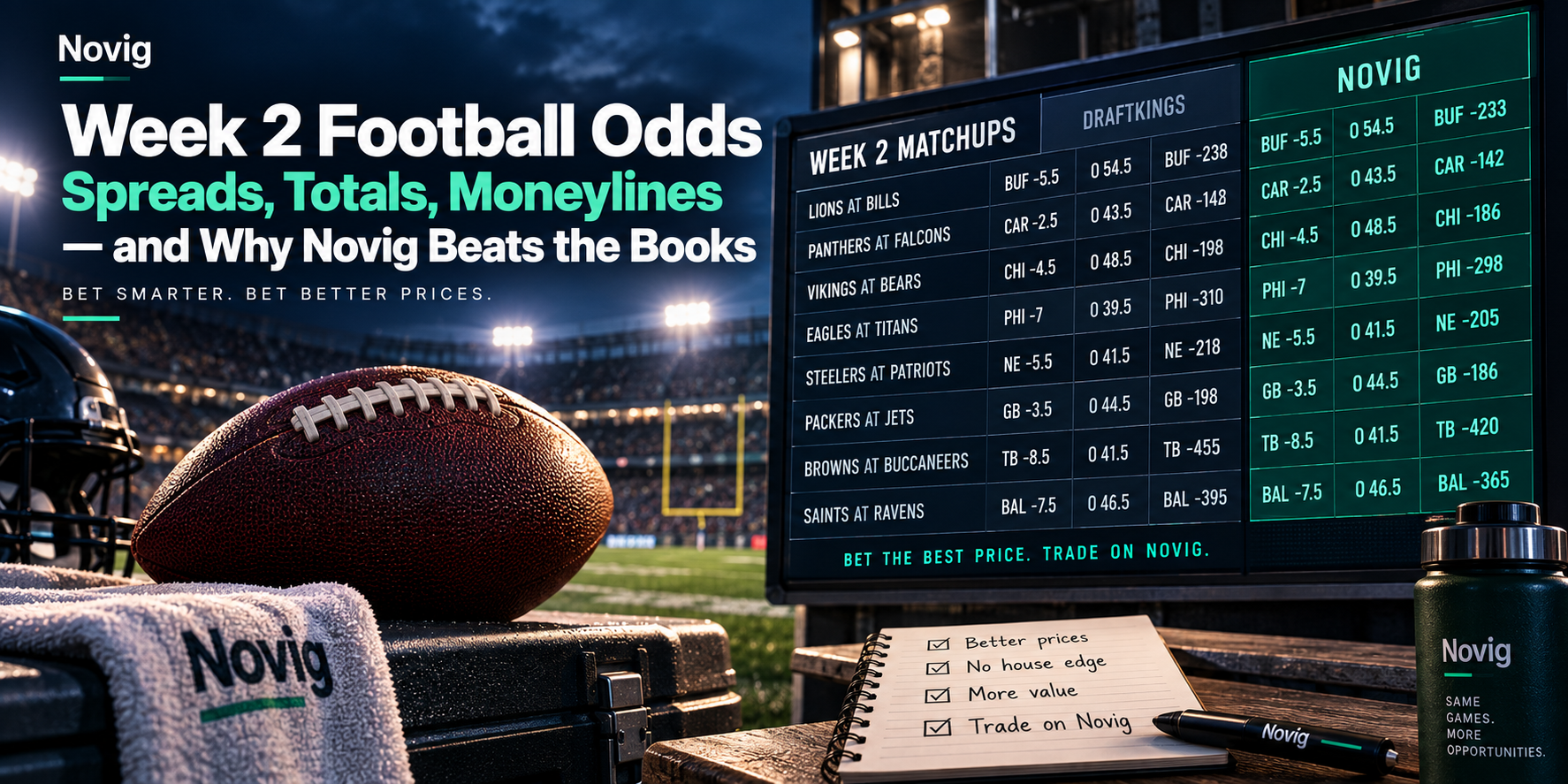
Compare every Week 2 NFL matchup for 2026, including spreads, totals, moneylines, home win probabilities, and DraftKings vs. Novig pricing.
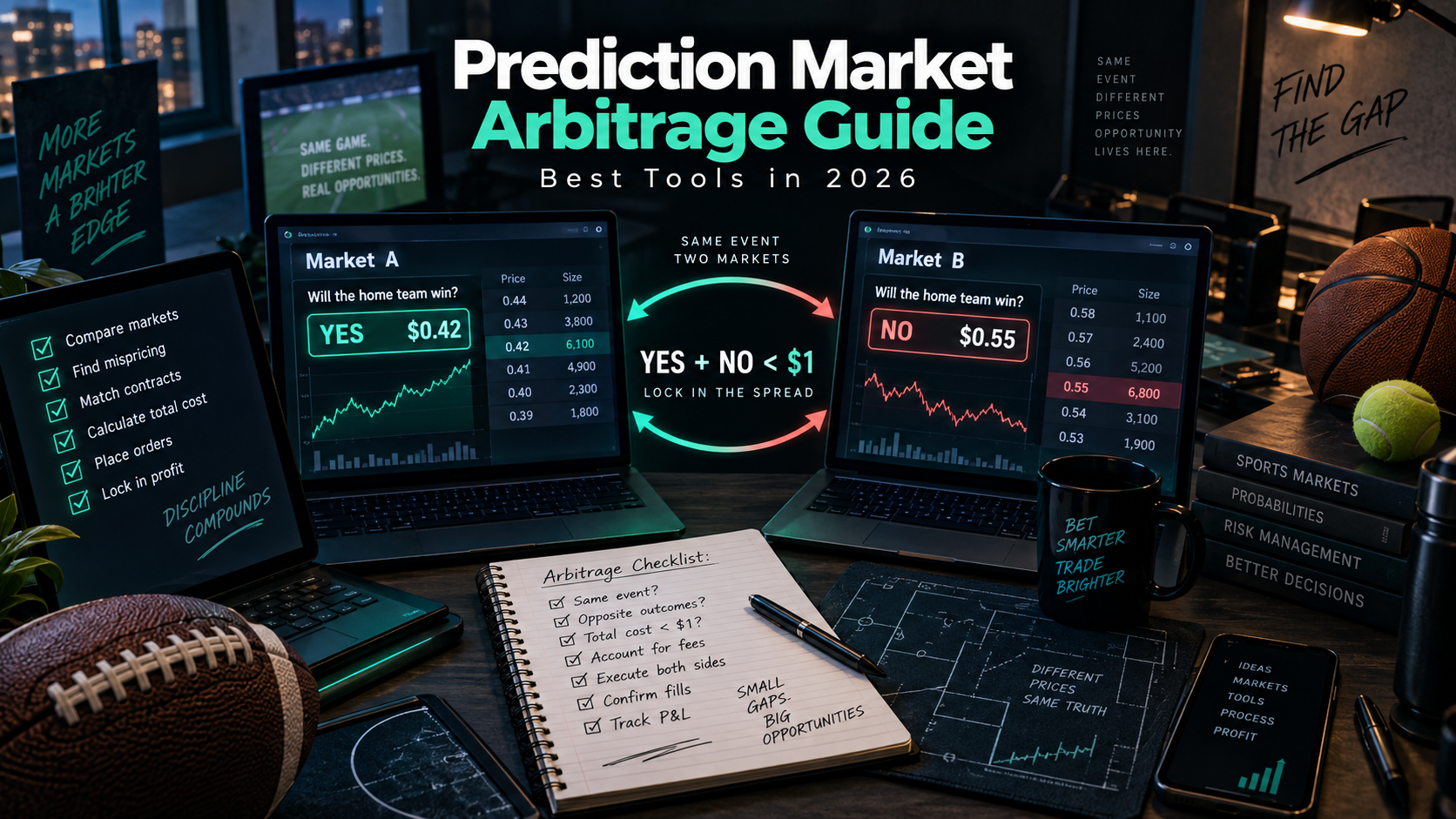
Prediction market arbitrage can lock in a return when two venues disagree on the same outcome. Learn how to verify real arbs and compare the best tools for finding and executing them.