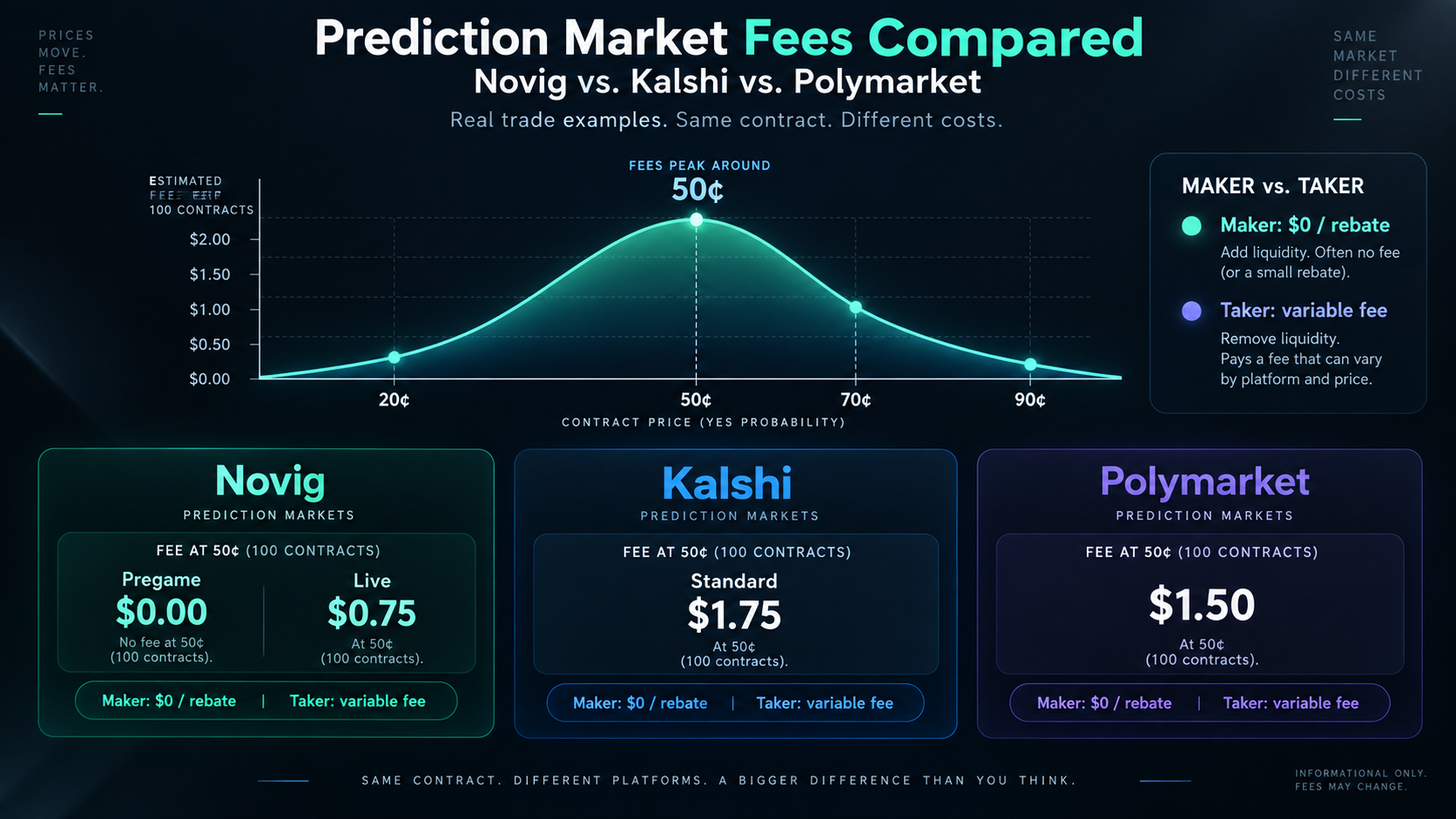
Prediction Market Fees Compared: Novig vs. Kalshi vs. Polymarket
Prediction-market fees add up quickly for active traders. Compare Novig, Kalshi and Polymarket with real examples showing what the same trades cost on each platform.
READ FULL ARTICLE
0
1
2
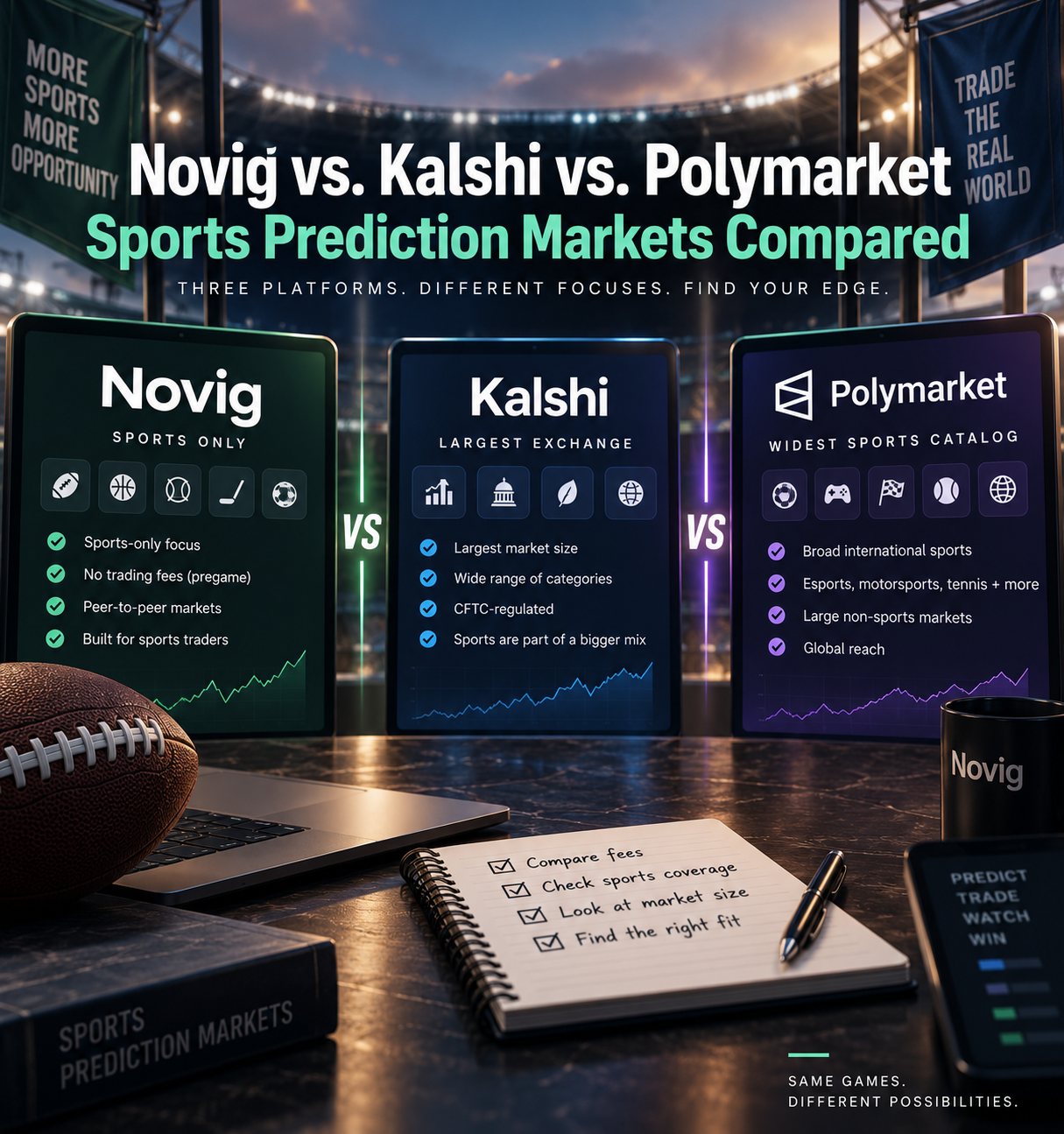
Novig, Kalshi and Polymarket overlap heavily on sports, but the platforms have three different priorities. Novig is the pure sports play. Kalshi is the largest all-purpose prediction exchange. Polymarket sits between them: sports currently dominate its activity, but it also offers politics, crypto, weather and other events while reaching further into international and niche sports.
If you mainly want to trade NFL, basketball, baseball and other familiar sports markets, Novig is the most focused option. Kalshi makes more sense if sports are one part of a larger prediction-market portfolio. Polymarket is the middle ground for someone who still prioritizes sports but wants more soccer, esports and long-tail leagues alongside non-sports markets.
| Metric | Novig | Kalshi | Polymarket |
|---|---|---|---|
Sports focus | 5/5 | 3/5 | 4/5 |
Non-sports markets | No | Extensive | Yes |
Sports reach | U.S.-sports-heavy | Broad | Broad international and niche mix |
Pregame straight fees | No trading fee | Transaction fees | Taker fee; maker rebate |
Recent U.S. exchange volume share | ~1.5% | 86.4% | ~7.5% |
Sports focus is our editorial rating based on platform scope and recent trading mix.
Recent U.S. exchange volume share reflects the Aug. 25 to 31, 2026 week reported by The PM Pulse/Aldrin, which put combined volume at $12.2 billion across the CFTC-regulated exchanges it tracks: Kalshi $10.5B, Polymarket $911M, Novig $185M, Rothera $149M and DKeX $32M. It measures overall platform scale, not liquidity on a specific market.
Novig's current official lineup covers professional and college football, baseball and basketball, plus hockey, tennis, golf and MMA, along with Canadian football, the World Baseball Classic and women's pro and college basketball. Its listed soccer contracts cover MLS. Football, basketball and baseball especially go deep into the markets bettors already use: moneylines, spreads, totals, partial-game lines, team totals, player props and futures. That makes Novig's layout familiar to anyone coming from a traditional sportsbook. Also, there's no election, Bitcoin or weather markets tabs competing for attention. Novig is built for people who came to trade sports.
Novig also has the cleanest pregame fee setup of the three. Straight trades made before an event starts currently carry no maker or taker trading fee. Live takers pay a small fee, while makers remain fee-free.
Pros: Entire platform is built around sports; deep markets for major U.S. leagues; no trading fee on pregame straight trades.
Cons: Smaller overall exchange than Kalshi or Polymarket; current official sports list is narrower outside the major U.S. leagues.
Kalshi is operating at a completely different scale. During the week of Aug. 25 to 31 it took $10.5 billion of the $12.2 billion traded across the CFTC-regulated exchanges The PM Pulse tracks, or 86.4%. Sports alone generated $3.1 billion that week, but they represented only 29.4% of Kalshi's volume. Exotics, crypto and commodities made up most of the rest. That mix explains how Kalshi works, as a prediction market first and a sports platform second. Users are typically looking to trade crypto prices, weather, elections or economic releases with football or basketball on the side. Its sports markets are still extensive: Kalshi supports game markets, spreads, totals, props, season-outcome contracts and multi-leg Combos, so choosing Novig over Kalshi is more about what features and ecosystem you prefer.
Kalshi charges transaction fees rather than offering Novig's blanket fee-free pregame straight trades, although the exact cost depends on the market, contract price and order type. We'll compare those formulas separately in our prediction-market fees guide.
Pros: By far the largest regulated exchange of the three; enormous absolute sports volume; the widest range of non-sports markets of the three.
Cons: Sports are only one part of the platform; transaction fees apply to trades that would currently be fee-free pregame on Novig.
Polymarket fills the gap between them. Sports dominate its activity in a way they do not at Kalshi, where sports were 29.4% of volume over the same Aug. 25 to 31 period. But unlike Novig, Polymarket also lists politics, crypto, weather, economics, technology and culture markets.
Its sports catalog also goes further into niche markets; beyond the major U.S. leagues, current markets and liquidity programs include Premier League, Champions League, La Liga, Serie A and Bundesliga soccer; Formula 1 and NASCAR; cricket; darts; table tennis; esports; ATP and WTA tennis; and UFC. So Polymarket's buyer pitch is more sports-focused than Kalshi, broader than Novig. You get a large sports marketplace with more international and niche coverage, while still carrying the politics and current-events markets that prediction markets started with.
Polymarket charges taker fees and pays rebates to makers, so it doesn't match Novig's zero-fee pregame straight structure. It also runs dedicated liquidity-reward programs that pay users for posting competitive resting orders in selected markets.
Pros: Strong sports emphasis; much wider international and niche sports coverage; non-sports markets are available without becoming the platform's main focus.
Cons: Taker fees apply; overall regulated U.S. volume is still far below Kalshi's.
For the major U.S. leagues, all three are legitimate sports platforms. Novig's narrower focus makes it particularly easy to move through football, basketball, baseball and hockey markets without wading through unrelated event contracts.
Polymarket wins on range today. Its current sports marketplace reaches into more soccer leagues, esports, motorsports and smaller international competitions, while still supporting spreads, totals and props on the major U.S. sports.
Kalshi sits behind neither in absolute sports activity. It traded $3.1 billion in sports contracts during Aug. 25 to 31 alone. But the reason to choose Kalshi is less about finding another sport and more about everything else the account can trade.
For a straightforward pregame sports position, Novig has the clearest advantage: no trading fee on pregame straight trades, whether you make or take the order.
Kalshi charges transaction fees, with rates depending on contract price and market rules. Polymarket also charges takers while rebating makers. Those differences become more complicated once trade size, live markets and resting orders enter the picture, so view the full dollar-by-dollar breakdown in our dedicated Novig vs. Kalshi vs. Polymarket fees guide.
For this comparison, the useful takeaway is simple: Novig is the cheapest of the three for pregame straight sports trades under the current fee schedules.
Kalshi is far larger today. Its 86.4% share of recent regulated-exchange volume dwarfs Polymarket at roughly 7.5% and Novig at roughly 1.5%. But total exchange volume isn't the same as liquidity on the contract in front of you. Kalshi's billions include huge amounts of non-sports trading, while Novig's entire business is sports. A deep NFL market on a smaller exchange can still offer a better price than the same market on the overall volume leader.
Check the available price and size before trading rather than treating market share as a substitute for the order book.
Choose Novig if sports are essentially all you care about. It stays focused on sports, covers the major U.S. leagues in depth and currently charges no trading fee on pregame straight positions.
Choose Kalshi if you want the largest exchange and plan to trade more than sports. It dominates current regulated prediction-market volume and gives you one account for games, economics, politics, crypto, weather and other events.
Choose Polymarket if sports are still the priority but you want a wider menu. It sits naturally between the other two: far more sports-heavy than Kalshi, less narrowly focused than Novig, and particularly strong in soccer, esports and other international or niche competitions.
Active traders can also use more than one. Prices are set independently across the exchanges, so comparing the same market before placing a position can matter more than committing to a single platform.
Which is better for sports, Novig, Kalshi or Polymarket?
Novig, if sports are the only thing you trade. It is sports-only, goes deep on the major U.S. leagues and currently charges no trading fee on pregame straight trades. Kalshi is better if you want one account for sports plus economics, politics, crypto and weather. Polymarket is better if your sports calendar runs past the major U.S. leagues.
Which one has the lowest fees?
Novig, for a pregame straight trade, where makers and takers both currently pay nothing. Kalshi charges transaction fees that vary by market and contract price. Polymarket charges takers and rebates makers.
Is Kalshi bigger than Novig?
Considerably. Kalshi took 86.4% of tracked CFTC-regulated exchange volume during Aug. 25 to 31, 2026, against roughly 7.5% for Polymarket and roughly 1.5% for Novig. Most of Kalshi's volume is not sports.
Can you use more than one?
Yes, and active traders generally should. The three set prices independently, so the best number on a given market moves between them.
Novig is built around sports from the start. Familiar markets, live trading, make-or-take pricing and no trading fees on pregame straight trades give users a different proposition from the larger general-purpose exchanges.
Compare the latest prices and trade sports markets on Novig.
1
2
2
Prediction-market fees add up quickly for active traders. Compare Novig, Kalshi and Polymarket with real examples showing what the same trades cost on each platform.

Compare five leading sports prediction markets by sports depth, fees, scale and overall fit. See which platform makes the most sense for how you trade.
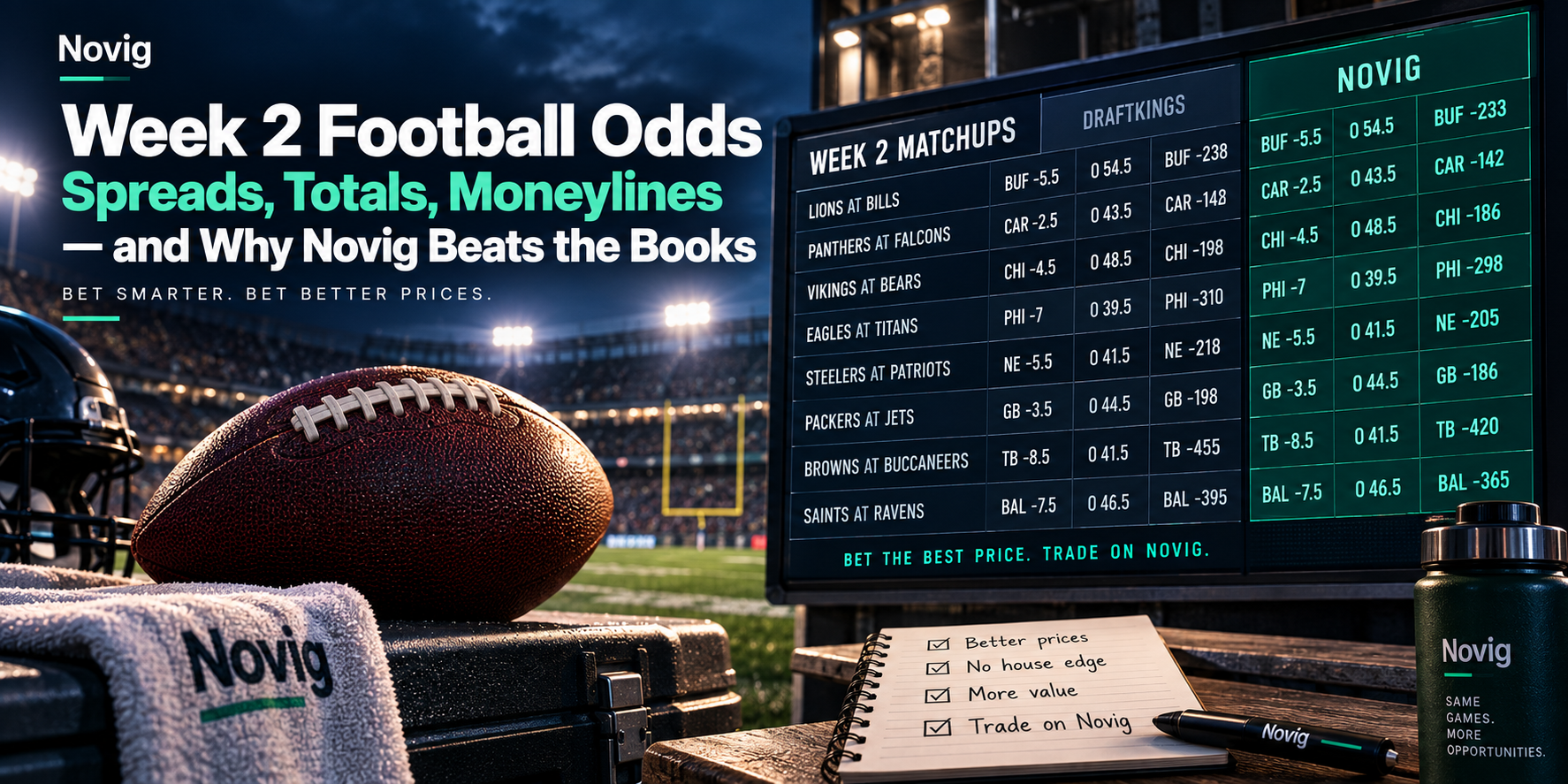
Compare every Week 2 NFL matchup for 2026, including spreads, totals, moneylines, home win probabilities, and DraftKings vs. Novig pricing.